


The Role of a PCSA in Reducing Project Risk
At a Glance:
- Objective: To bridge the information gap between RIBA Stages 3 and 4.
- Key Benefit: Eliminates “Risk Pricing” by subcontractors through transparent site investigation.
- Outcome: A Fixed Price and a validated construction programme before the main contract is signed.
Understanding the Information Gap
In a traditional “Single Stage” tender, a contractor is often asked to price a project with incomplete information regarding the existing building fabric. This leads to Risk Allowances—inflated costs added to cover unknowns.
A Pre-Construction Services Agreement (PCSA) allows us, as your project partner, to join the design team early. Our role is to identify where the design meets the reality of the site, specifically focusing on buildability, sequencing, and long-term cost certainty.
Key Deliverables During the PCSA Phase
As a firm with both Building Surveying and Principal Contracting expertise, we focus our PCSA involvement on four critical pillars:
1. Technical Site Investigation (The Surveyor’s Eye)
We don’t just look at drawings; we “open up” the building.
Intrusive Surveys: Identifying hidden structural members or asbestos that a desk study might miss.
Services Verification: Tracing existing MEP (Mechanical, Electrical, Plumbing) to ensure new designs are compatible.
Condition Reports: Documenting the state of adjacent structures to mitigate future Party Wall or damage claims.
2. Buildability & Sequencing Advice (The Contractor’s Hand)
A design may look perfect on paper but be impossible to execute within a live environment.
Logistics Planning: How do we get materials into a landlocked site or a live hotel without disrupting operations?
Temporary Works: Identifying the need for facade retention or complex propping early to avoid mid-project delays.
Subcontractor Market Testing: Engaging specialist trades early to lock in lead times and “real-world” pricing.
3. Risk Register Refinement
The PCSA turns “Unknown Risks” into “Managed Costs.” We work with the Project Manager to build a live Risk Register that Categorises:
Eliminated Risks: Issues we solved through early site investigation.
Transferred Risks: Issues the contractor will now take responsibility for.
Retained Risks: Issues that remain with the client (with a clear contingency budget attached).
4. Managing Stakeholders & Authorities
Early involvement allows us to liaise with Building Control, Fire Authorities, and Conservation Officers while the design is still fluid. This prevents the “stop-start” delays often seen during the delivery phase when authorities request changes to a finalized design.
The Principal Contractor’s Perspective: Why it Matters
From a delivery standpoint, a project that has undergone a robust PCSA phase is a “clean” project. It allows us to hit the ground running on Day 1 of the main contract, with a site team that already understands the building’s constraints and a supply chain that is fully committed to the programme.
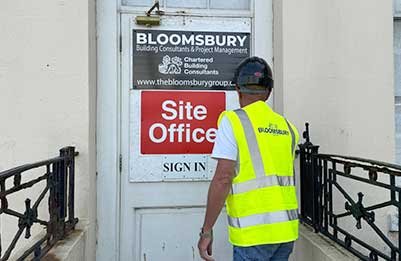
Applied Expertise: During the pre-construction phase of the Royal Albion Hotel restoration, early contractor involvement was vital in assessing structural stability following fire damage before full site mobilization. This allowed for a safer, more predictable demolition and stabilization phase.
At The Bloomsbury Group, our CIOB membership is more than just a credential – it’s a reflection of our unwavering commitment to excellence in construction management. We take pride in upholding the high standards set by the CIOB and continuously strive to exceed them in every project we undertake.
Contact The Bloomsbury Group today to discover how our CIOB membership and commitment to professional excellence can benefit your next construction project.